
Article: CPSC Warning: OUSPT Snorkel Mask = Kaimana Mask from Germany
CPSC Warning: OUSPT Snorkel Mask = Kaimana Mask from Germany
Updated: May 2026 · Sources: CPSC, SaferProducts.gov, Hawaii Snorkel Safety Study
On March 5, 2026, the US Consumer Product Safety Commission (CPSC) issued an official warning against the OUSPT full-face snorkel mask: stop using immediately — risk of breathing difficulty, unconsciousness, and drowning. 84,000 units were sold through Amazon in the US alone.
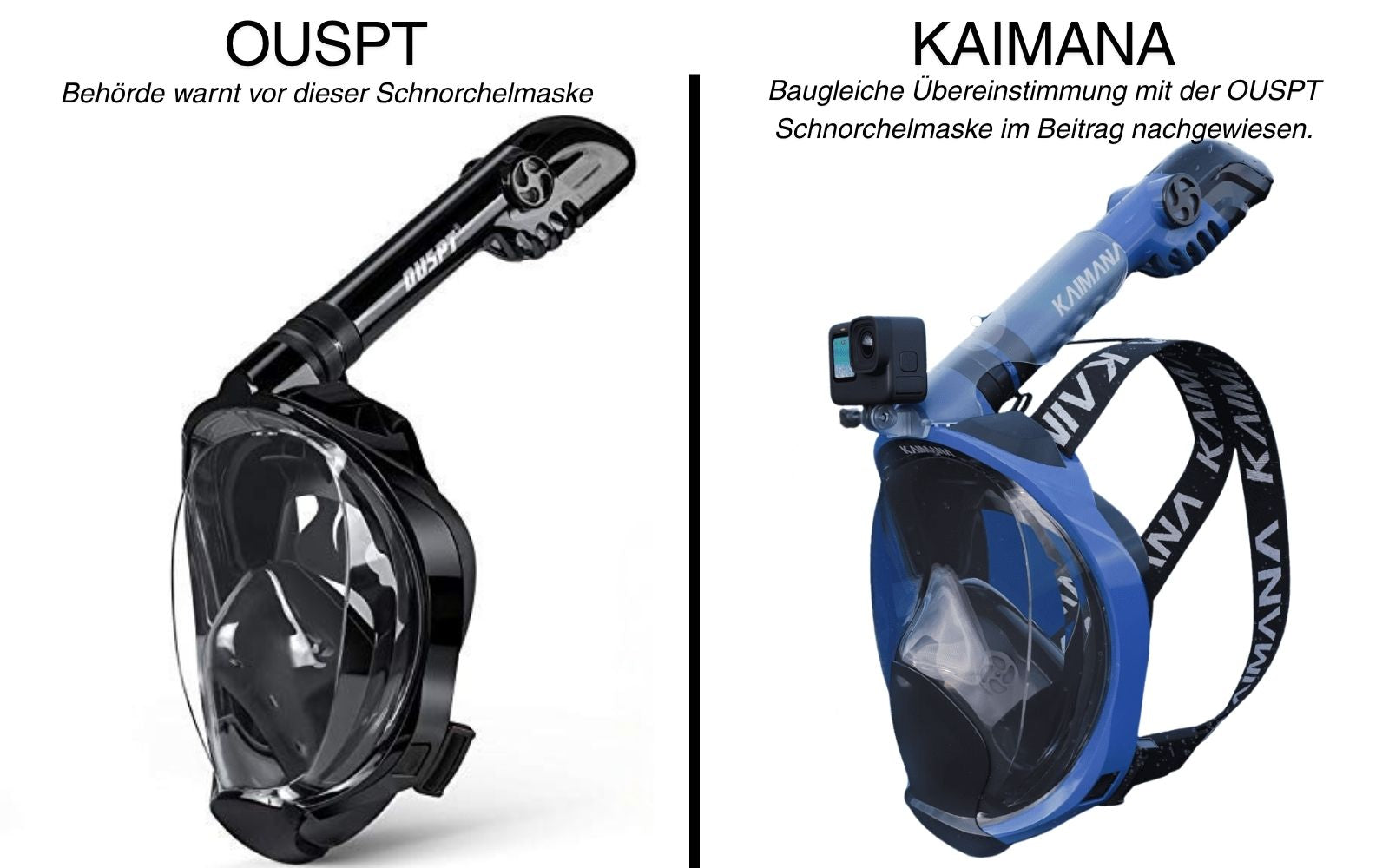
What many people don't know: it's exactly the same mask sold in Germany under the name Kaimana as a supposed Amazon bestseller. A generic 8-dollar product from China — just with a different logo printed on it.
Contents
What did the CPSC find?
The U.S. Consumer Product Safety Commission (CPSC) — the American equivalent of a national consumer protection agency in Europe — has published Warning No. 26-311. It addresses all owners of an OUSPT full-face snorkel mask with a clear message: stop using the mask immediately.
Normally, in such cases, the CPSC works with the manufacturer and organizes an orderly recall. What makes this case unusual: the manufacturer — a Chinese company called Field Life — did not respond to a single inquiry from the US agency. No statement, no cooperation, nothing. That's why the CPSC had to take the unusual step of issuing a public warning without the manufacturer's involvement.
The CPSC has received five consumer reports of breathing problems, dizziness, and loss of consciousness. In addition, there is a lawsuit alleging that the mask caused a death by drowning.

Image source: U.S. Consumer Product Safety Commission (cpsc.gov)
The product: OUSPT Full-Face Snorkel Mask
| Detail | Information |
|---|---|
| Brand | OUSPT |
| Seller | Field Life (China) |
| Sold via | Amazon.com |
| Sales period | March 2019 – February 2026 |
| Units sold | approx. 84,000 |
| Manufactured in | China |
| Identifying feature | "OUSPT" printed on the snorkel tube |
The mask is marketed as a full-face snorkel mask with 180° panoramic vision, a detachable camera mount, and a "safety breathing system." It comes in various colors.

OUSPT Full-Face Snorkel Mask — Image source: CPSC

Close-up: "OUSPT" on the snorkel tube — Image source: CPSC
Why are these masks dangerous?
The CPSC cites three specific dangers:
1. Difficulty breathing and loss of consciousness
The mask can make breathing so difficult that the wearer loses consciousness. In the water, this is a deadly situation — anyone who becomes unconscious can no longer stay above the surface and drowns.
2. Elevated CO₂ levels (carbon dioxide rebreathing)
Stale air accumulates inside the mask. The carbon dioxide you exhale is not completely vented away and is partially breathed back in. This phenomenon is called rebreathing or CO₂ rebreathing. The result: headaches, dizziness, disorientation — and in the worst case, unconsciousness.
3. Fluid accumulation in the lungs (pulmonary edema)
Difficult breathing can lead to what's called ROPE (Rapid Onset Pulmonary Edema) — a sudden accumulation of fluid in the lungs. This is a medical emergency that is life-threatening even outside of the water.
Deaths and serious incidents worldwide
Hawaii: the epicenter
Between 2014 and 2023, 225 tourists and 62 residents drowned while snorkeling in Hawaii. The rise in deaths correlates directly with the growing prevalence of full-face masks starting in 2014:
- 2010–2014: 82 snorkeling-related drowning deaths among visitors
- 2015–2019: 114 snorkeling-related drowning deaths among visitors (an increase of approximately 39%)
A survey of 131 surviving snorkeling emergency patients found that 37% were wearing a full-face mask.

Source: Hawaii Snorkel Safety Study (2019–2022) · Graphic: Khroom
The Germany connection: OUSPT, Kaimana, and Alibaba
And here's where it becomes relevant for European consumers.
The Alibaba problem
The OUSPT mask is not a product developed in-house. It's a generic mass-produced item from China, available on platforms like Alibaba for around 8 US dollars per unit. Various brands buy these masks in large quantities, have their own logo printed on them, and then sell them as their "own product" — often for 30 to 50 euros.

Left: OUSPT (CPSC warning) · Right: Kaimana (Amazon.de) — Same mask, different logo
The component-by-component proof: why it's exactly the same mask
So far, we've claimed that OUSPT and Kaimana are structurally identical. But is that actually true? We checked.
To do this, we ordered an original Kaimana mask on Amazon.de and compared it component by component with the official product images of the OUSPT mask from the CPSC report. The result is unambiguous.
Comparison 1: breathing channel, valves, and frame

Markings *1 and *1.1: Identical air intake, identical valve arrangement, identical frame
In the upper area (markings *1 and *1.1), both masks show the same extremely narrow air intake. The valves are indistinguishable in arrangement, shape, and size. The frame, too, looks identical at first glance.
Comparison 2: silicone flap beneath the breathing channel

Markings *1.2 and *1.3: The same silicone flap — the green-highlighted area shows a purely decorative cap with no functional impact
Beneath the breathing channel (*1.2 and *1.3), both masks have the same silicone flap. The only visible difference: a small decorative cap, marked in green in the image. It is purely decorative and has no influence whatsoever on breathing behavior or valve function. We'll come back to this point in a moment — it's essential for understanding what's really going on here.
Comparison 3: exhalation valve, snorkel locking mechanism, and inner frame

Markings *1.4 and *1.5: Structurally identical components in several places
This comparison (*1.4 and *1.5) reveals several matching elements at once:
- Top right: the same exhalation valve — indistinguishable in design and positioning
- In the snorkel: the same locking mechanism
- Exhalation channel: the same unusually narrow passage
- Bottom right: the same quick-release buckle in exactly the same spot
- Inside: the same transparent plastic frame that joins the silicone to the mask body
Comparison 4: air valve, decorative fin, and mask top

Markings *1.6 and *1.7: The most striking matches — decorative fin and uniquely designed air valve
Here, the most pronounced matches become visible (*1.6 and *1.7):
- On top of both masks sits a purely decorative fin — identical in shape, position, and execution.
- The air valve above the mouth and nose chamber doesn't exist in this specific form on any other snorkel mask we know of on the market. This unusual design is an unmistakable identifying feature.
Here too, the green circle marks only a decorative cap — it plays no functional role.
Why do only two parts differ? The answer: tooling costs.
Why did the manufacturer make even two tiny visual changes if the function remains 100% identical? The answer is straightforward economics.
That's exactly what happened here. With an investment of just a few thousand US dollars, two purely decorative components (the elements marked in the green circles) were adapted. The rest — and thus all functionally relevant components such as the valve system, breathing channel, inner frame, quick-release buckle, and airflow routing — was carried over unchanged.
And why bother with this minimal change at all? Amazon. The marketplace's rules can merge two visually identical products under different brands or block listings. With this minimal design update, the Kaimana can be listed as a "standalone product" — but functionally, it remains the same model the CPSC explicitly warns against.
The supply chain closed: direct contact with the manufacturer
To close the loop completely, we have internal communications with the Chinese manufacturer whose product portfolio includes this mask model.

Excerpt from a WeChat communication with the manufacturer — both mask variants are listed in the product portfolio
This excerpt confirms what the component comparisons have already shown: on the manufacturer's product page, both mask variants — the OUSPT and the Kaimana versions — are offered side by side. Both unbranded, ready for any reseller who wants to have their own logo and packaging printed on them. The purchase price: less than 8 US dollars per unit (approximately €6.88 — as of May 2026), including packaging and custom branding.
Kaimana: the same product under a German name
On Amazon.de, a full-face snorkel mask is sold under the brand name Kaimana that strikingly resembles the OUSPT model. Behind Kaimana stands hoodoo commerce GmbH, based in Hanover, Germany (HRB 220196).
What we know about the Kaimana mask:
- No in-house development: The mask is not developed or improved by Kaimana — it comes directly from a wholesaler.
- Alibaba standard model: The same base model is available on Alibaba for around 8 USD.
- No independent CO₂ certification: No TÜV, no SGS, no DEKRA — no independent body has tested this mask's CO₂ levels.
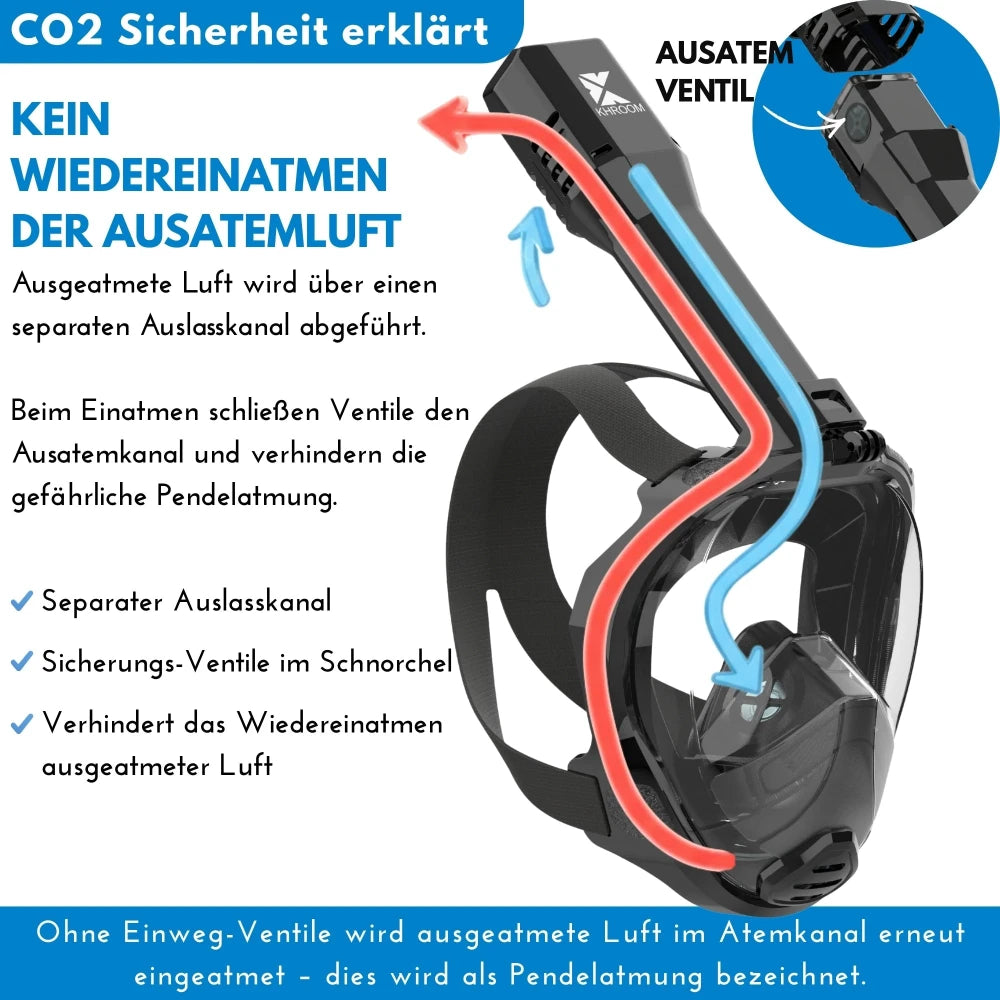
- Breathing channel too narrow: The central breathing channel is extremely narrow and even tapers down to roughly the diameter of a 1-cent coin. This increases breathing resistance and worsens the CO₂ problem.
- Audible breathing noises: When breathing, a clearly audible whooshing sound is produced — a sign that the airflow is not being efficiently guided.

The narrowed breathing channel of the Kaimana mask — barely wider than a 1-cent coin
The comparison: what distinguishes safe masks from unsafe ones?
| Criterion | OUSPT / Kaimana | Safe full-face masks |
|---|---|---|
| CO₂ certification | None | TÜV / SGS / DEKRA certified |
| Breathing channel separation | Insufficient / too narrow | Real physical separation |
| In-house development | No — Alibaba goods | Own design & development |
| Factory price | approx. 8 USD | Significantly higher production costs |
| Manufacturer response | None (OUSPT ignored the CPSC) | Accountable contacts |

Graphic: Khroom Sport
What to look for when buying
If you own or are considering buying a full-face snorkel mask, watch out for the following points:

Graphic: Khroom Sport
View Seaview Pro (SGS certified) View Seaview Kids (TÜV certified)
Sources
- CPSC Warning No. 26-311 (March 5, 2026): CPSC Warns Consumers to Stop Using OUSPT Full Face Snorkel Masks
- Coroner's Report on Angela Kearn (UK, 2023): Prevention of Future Deaths Report — judiciary.uk
- Hawaii Snorkel Safety Study (2019–2022): Final Reports — snorkelsafetystudy.com
- Hawaii Resolution HCR123 (2019): capitol.hawaii.gov
This article is for consumer information. All information is based on publicly available sources, which are linked in the sources section.

Written by Christian Hanauer


%20issued%20an%20official%20warning%20against%20the%20OUS...)